

Head and neck cancers
If cancer of the head and neck is found and treated early, you have a good chance of getting better.
Click on the headings below to learn more.
Head and neck cancer is a general term that doctors use. It covers many different types of cancer. Even though these cancers are different, they are treated in the same way, so are often grouped together.
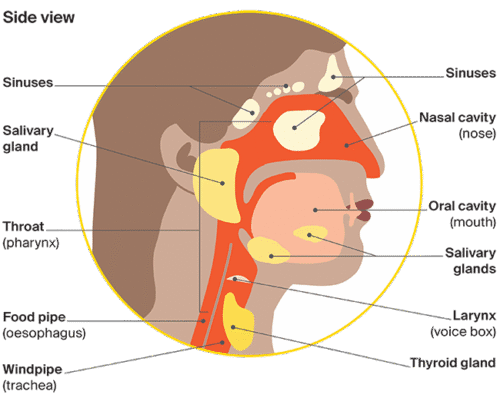
Cancer can start anywhere in the head and neck, including the mouth, voice box, sinuses (hollow spaces in the skull), nose, lips, tonsils, salivary glands and throat.
Head and neck cancers are named after where they started:
 |
Mouth or oral cancer
Starts anywhere in the mouth, including the lips, inside the cheeks, the tongue, floor of the mouth, jaws and gums. |
 |
Salivary gland cancer
Starts in the glands in front of the ears, underneath the jaw or below the tongue. |
 |
Pharyngeal cancer
Starts in parts of the throat (pharynx). |
 |
Laryngeal cancer
Starts in the voice box (larynx). |
 |
Nasal cancer or paranasal sinus cancer
Starts in parts of the nose (nasal cavity or sinuses). |
Head and neck area
Common signs of head and neck cancer include:
- red or white patches in the mouth or an ulcer that doesn’t heal after a few weeks
- pain when chewing or swallowing, or a constant sore throat
- changes to your voice
- a swelling or lump in the face, mouth or neck
- an earache on one side.
These signs do not always mean you have cancer, but it’s important to see your doctor if you notice these or any other unusual symptoms.
You may have some tests to check if you have cancer. These could include:
- Physical examination – Your doctor will carefully check your ears, nose, neck, eyes and throat.
- Biopsy – Your doctor will take a sample of cells from the area that looks abnormal. They will use a needle for this.
- Endoscopy – This test looks at the nose and throat area using a thin, flexible tube with a light and camera on the end. First, the doctor sprays a local anaesthetic (which tastes bitter) into one of your nostrils to numb the nose and throat. The tube is then gently passed into the nostril and down your throat.
- Microlaryngoscopy – This test is done in hospital while you are asleep (with a general anaesthetic). A stainless steel instrument called a laryngoscope is put into your mouth to hold your throat open while the doctor checks your throat.
- Imaging tests – These tests use a computer to create a picture of the inside of your body. They include ultrasounds, x-rays, CT (computerised tomography) scans and MRI (magnetic resonance imaging) scans.
These tests can feel uncomfortable, but they often only take a few minutes.
If you feel uncomfortable having any test, ask a nurse, Aboriginal and Torres Strait Islander health professional or someone from your family or mob to be in the room with you.
The test results will tell the doctor what type of head and neck cancer you have and if the cancer has spread (the stage). This information helps the doctors work out the best treatment for you.
- Stage 1 – The cancer is small and only in one area (localised).
- Stage 2 and 3 – The cancer is more advanced and may have spread to nearby lymph nodes (small glands).
- Stage 4 – The cancer is advanced.
There are different types of treatment for head and neck cancer.
You may have one or more of these treatments:
- Surgery may be needed to remove the lump or cancer, if possible. Sometimes lymph nodes around the cancer are removed too.
- Sometimes called chemo, chemotherapy is strong medicine that can kill or damage the cancer cells.
- Also called radiotherapy, radiation therapy uses x-rays to destroy the cancer cells.
- It’s usually given from outside the body (external beam radiation therapy).
- You can have radiation therapy on its own, or after surgery.
Other medicines
- Some special medicines, like targeted therapy or immunotherapy, can treat advanced head and neck cancers.
Going to all your treatment sessions gives you the best chance of a good result.
Treatment for head and neck cancer can sometimes cause problems. These are called side effects.
Some of the common ones include:
- redness in the area treated by radiation therapy
- sores in your mouth
- difficulty in swallowing, a dry mouth, or thick spit (saliva)
- changes in taste or how you talk
- feeling sick, like you might vomit (nausea).
 |
Yarn with mob
It’s normal for you and your family to have lots of different feelings right now. Yarning with someone you feel comfortable with can provide support. |
 |
Ask questions
You may have many questions about the cancer, its treatment and how it will affect you. Your doctor, nurse or Aboriginal and Torres Strait Islander health professional will help answer any questions you may have. |
 |
Get help with travel
If you have to travel a long way for treatment, you can get help to pay for travel and somewhere to stay. For more information, call 13 11 20. |
 |
Find support
Call 13 11 20 if you or anyone close to you needs support. |
This information was adapted for Aboriginal and Torres Strait Islander peoples by Menzies School of Health Research in consultation with a clinical advisory group and an Indigenous consultation group. Cancer Council NSW has updated this fact sheet in consultation with cancer experts and Aboriginal people with an experience of cancer. We thank all reviewers and acknowledge the generous sharing of cultural knowledge by: Leon Avuri-Williams, Ngambri man and Aboriginal Health Practitioner, NSW; Lisa Fletcher, Ngarabul and Kamilaroi woman and Aboriginal Liaison Nurse, Mid North Coast Cancer Institute, NSW; Kirsty Glanville, Wiradjuri woman and Aboriginal and Torres Strait Islander Service Design Lead, Cancer Council Australia; Allyra Hulme, Wiradjuri woman and National Indigenous Program Manager IPEPA, Cancer and Palliative Care Outcomes Centre, Centre for Healthcare Transformation, Queensland University of Technology, QLD; Kristy Stewart, Juru woman and Consumer. We also thank A/Prof Martin Batstone, Oral and Maxillofacial Surgeon and Director of the Maxillofacial Unit, Royal Brisbane and Women’s Hospital, QLD.